The Push for a New Hospital in Lakewood Turns to an Expert.
Creating a new hospital is a massive undertaking. Creating a new hospital that runs according to halachah is even more daunting.
That’s why, as they attempt to do just that in Lakewood, the health organization Chemed turned to one of the stalwarts in the world of halachically-compliant medical
centers: Laniado Hospital in Netanya, founded by the Sanz-Klausenberger Rebbe, zt”l.
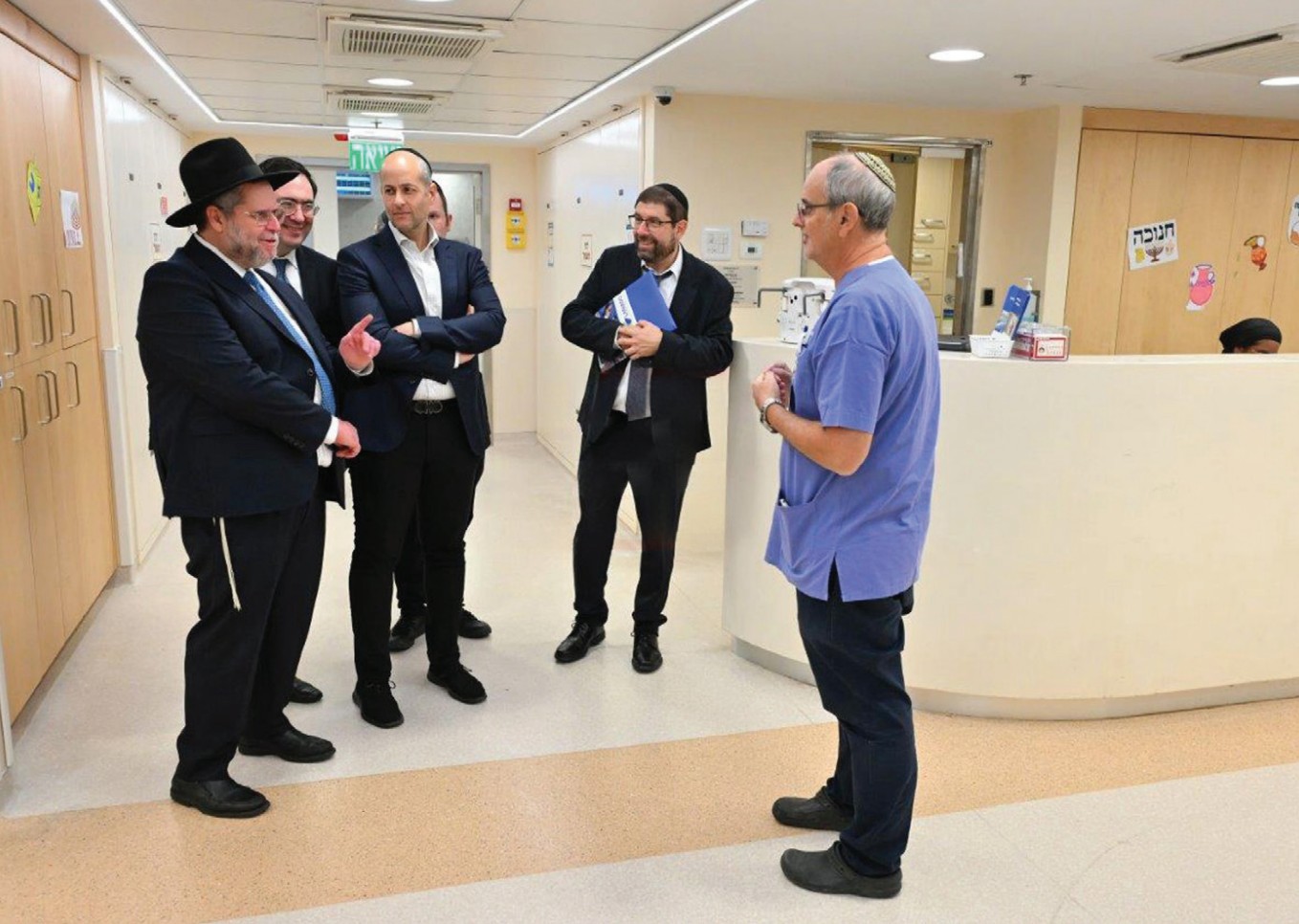
Representatives of Chemed recently traveled to Eretz Yisrael to visit a number of chareidi and dati hospitals to observe how they function as advanced medical centers within the purview of halachah. They were scheduled to spend only 90 minutes at Laniado, but they ended up remaining there for over five hours because there was just so much to be learned there.
The visit included a visit to the Sanzer Rebbe of Netanya, who explained how his father had persevered in creating a hospital that would be at the cutting edge of medicine but also strictly governed by Torah law.
In a statement about the visit, Dr. Dovid Friedman, the CEO of Chemed, said, “The care, compassion and mission that define Laniado Hospital are evident at every level. What takes place there each day is a true kiddush Hashem. The commitment to excellence in medicine coupled with uncompromising adherence to halachah is profoundly inspiring.”
Rav Aharon Shaya Spitzer, who served as the long-time secretary of the previous Sanz-Klausenberger Rebbe and leads American Friends of Laniado Hospital, spoke to Ami about the visit as well as the lessons that can be learned from this unique medical institution.
Rav Spitzer noted that when it was first built 50 years ago, Laniado was originally going to be just one hospital among many in Netanya. Instead, it remains the only hospital there, and it serves not just the city but also surrounding communities, with about 500,000 people in its service area.
He noted that there is a special skill in melding strict halachah and patient service.
“The rigid halachic standards don’t make it especially easy for someone who doesn’t appreciate that. Most of the patients are not necessarily frum; it’s the only hospital for the city, and Netanya is not a frum city.”
He noted that there are many special restrictions put in place, per the Rebbe’s instructions. On Shabbos, only one elevator is available, operated by an Arab attendant. Radios and telephones are silenced on Shabbos. No Jewish doctors write in
Laniado on Shabbos; instead, they dictate and Arab interns write for them. The Rebbe
maintained Rabbeinu Tam zmanim, so these restrictions extend relatively late into the night on Motzaei Shabbos and Yom Tov. Other halachic stringencies include serving only handmade matzos on Pesach (a practice that survived a legal challenge instigated by anti-religious activists).
Remarkably, these restrictions do not impinge on the patient experience. Just the opposite: They seem to enhance it.
“About a month ago, the government released a national survey about patient and family satisfaction at the hospitals. The national average was 81% satisfaction, and
Laniado was top in the country, with 88%.”
The explanation behind such a positive rating, Rav Spitzer posits, is the relationship of the medical and administrative staff with the patients. Every patient senses that the entire hospital staff cares about them and their lives. “The patients feel that, and the families feel that.”
Currently, Laniado itself is undergoing an expansion and renewal effort. One major expense, Rav Spitzer noted, is the new requirements for security. Because of missile threats, the hospital cannot simply remodel its above-ground structures; it must also dig three underground floors for the safety of patients and staff, which is very expensive.
Rav Spitzer related a personal experience he had in 1975, the year before the hospital
opened. The Rebbe was in his office, drafting the nine divrei yesod (governing principles) on which the hospital is based. The office of American Friends of Laniado
Hospital had been moved to the room next to the Rebbe’s sefarim room to save money
for the organization, and the Rebbe called Rav Spitzer in.
“The first thing the Rebbe would say was always, ‘Zai moichel’—Pardon me. The Rebbe told me, ‘Pardon me and please bring a few sheets of paper and a pen. And don’t let anybody come in. Even if a malach would want to come in, don’t let anybody disturb me.’ So I brought him the pen and paper.
“Then the Rebbe called me: ‘Please bring me a Gemara.’ So I brought it in. Again, he reiterated that I should not allow anyone to enter. I went back to my table.
“Then the Rebbe called me again: ‘Bring me a Shulchan Aruch, Yoreh Dei’ah and
Hilchos Shabbos.’ So I brought those in. I realized that he might need me again, so I
stood by the door near my office.
“I didn’t know what the Rebbe was writing, but the Rebbe was totally immersed in his thoughts and his work, when I suddenly began to feel that my feet were not on the ground. There was some special, I would call it ‘Ruach Hakodesh’ in the room.
“I cannot recall how long it took, but after the Rebbe finished, he gave the papers to me and said, ‘I want you to print it out.’”
It was exactly that kind of care by a gadol hador and talmid chacham that the Chemed representatives had come to learn about and emulate.
“I believe the Rebbe would be pleased that his example is being used to help other
Jewish communities,” Rav Spitzer said. “Whatever the Rebbe did, the Rebbe wanted
others to emulate him. The Rebbe used to say, ‘When do I know I did something good? When people emulate me.’”
The Rebbe’s foresight, which transformed Netanya and the surrounding communities, may soon have a similarly profound and beneficial effect on the population of all those in the Lakewood area

Site Sponsored by
insert
sponsor
logo
American Friends of Laniado Hospital is a registered 501(c)(3) organization (EIN: 13-272-4055). Contributions are tax-deductible as allowed by law.
Powered by Bottom Line Marketing Group
