In Critical Care, Patients Can Easily Become Diagnoses. At Laniado Hospital, They Remain Individuals. And When Skill Meets Faith and Perseverance, Miracles Can Happen.
Today in modern medicine the patient has unfortunately been downgraded behind the ego of the medical staff and the incredible medical technological advances in recent years. The patient has become an illness. The humanity and dignity aspect of medicine has been denigrated to the least of the medical team's priorities.
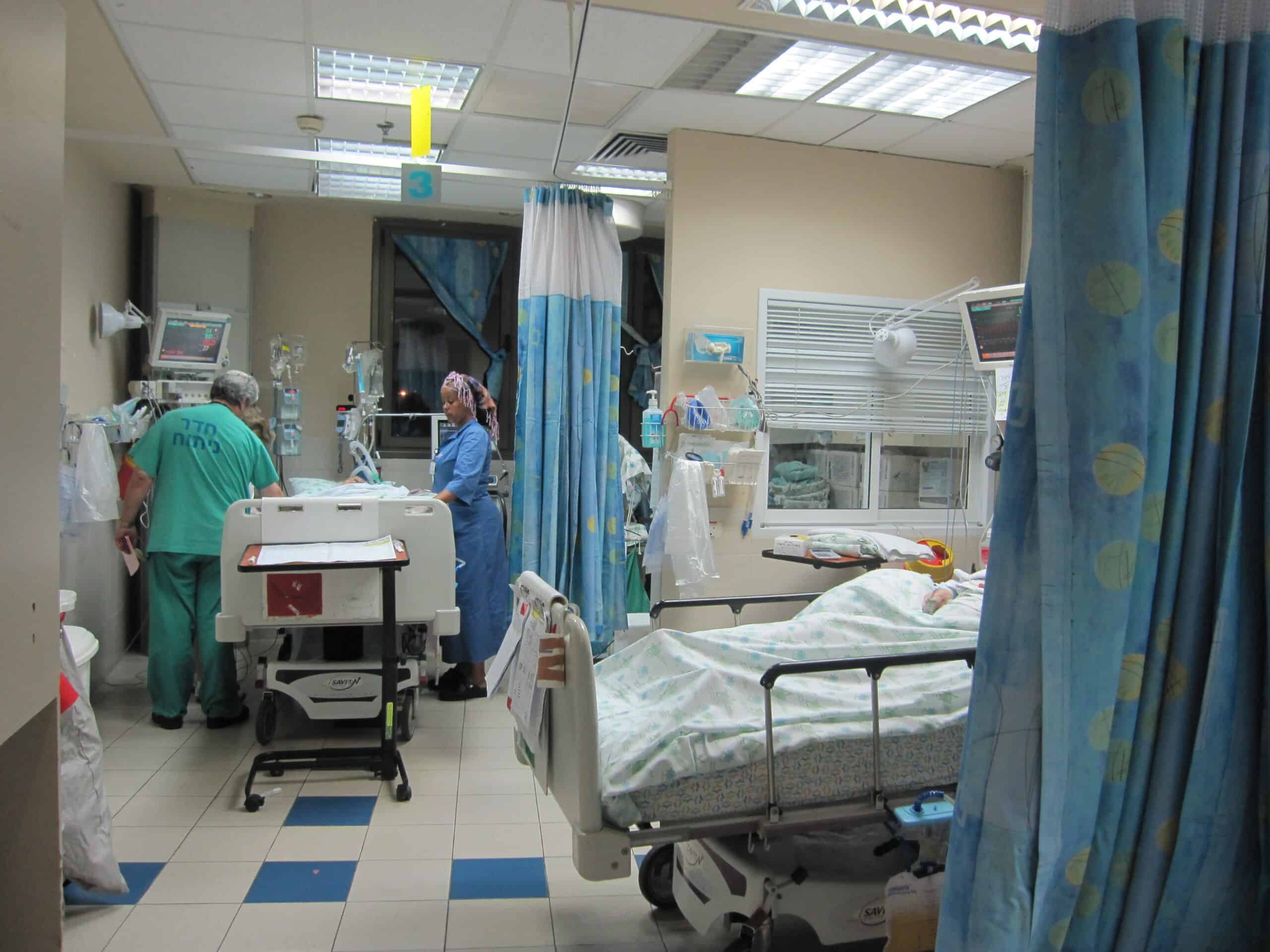
This is particularly true in the intensive care unit where most of the patients are sedated and ventilated and the survival of the critically ill patient is often determined by the skill of the medical team as well as advanced medical technologies and treatments.
Over the past 23 years I have had the great privilege of establishing and directing the general intensive care department at Laniado hospital. Despite Laniado being regarded as a "peripheral" community hospital, thank G-d our department has developed the reputation of giving excellent intensive care while maintaining the dignity and humanity of each and every patient, irrespective of the patient's pedigree, background, social and financial stations.
At Laniado the amazing, empathetic, caring nursing staff has lead the way in providing this outstanding care. The philosophy of putting the patient first has filtered down to our highly qualified medical staff.
In the general intensive care department at Laniado the patient is seen as a fellow human being who suffers from a severe illness and is treated accordingly.
Our department currently has enough staff to treat 10 patients. We treat over 600 patients a year.
I would like to share with you 3 of the many critically ill patients we have thank G-d treated successfully over the last 23 years.
Patient 1.
Soon after we opened our department, a foreign tourist who was visiting her daughter was admitted to Laniado in a critical condition after falling 3 floors while hanging up washing on the washing line. In the emergency room she was intubated and placed on an advanced ventilator and after comprehensive investigations she was found to have severe chest and lower back injuries. Due to the severe damage to her chest , with many fractured ribs and bilateral collapsed lungs (pneumothoraces), chest drains were inserted bilaterally with expansion of both her lungs . The severe injuries to her lower back were irreversible resulting in complete paralysis of both her lower limbs.
Unfortunately our patient had not organized medical insurance and her daughter being a new olah had no financial resources. The patient received high quality care from the surgical and orthopedic departments and after undergoing the necessary investigations and procedures she was admitted to our intensive care department in a critical state. Despite not having medical insurance or financial means the patient received the high standard of intensive care that our department provides, with no cost spared. After many days hovering between life and death, thank G-d she stabilized. She returned to full consciousness, was stable hemodynamically. Due to the severe damage to her lungs it was impossible to wean her off the ventilator, therefore we performed a tracheotomy (a breathing tube in her neck). The patient stabilized enough to be discharged to a rehabilitation hospital. She required the specialized care at a rehabilitation institute to teach her how to cope with her new life with paralyzed legs as well an effort to wean her off the tracheostomy tube. Because the patient had no medical insurance, not one of the rehabilitation centers in Israel agreed to admit the patient to their institutions. Although we are not a rehabilitation department we started the process of rehabilitation in our department including intensive physiotherapy, social and psychological support. A process was initiated to see if there was any way the patient could become a citizen of Israel. As we all know Israeli bureaucracy is extremely slow and cumbersome. Once the patient was weaned off the ventilator, with the administrations permission we transferred the patient to the surgical department where the nursing and medical staff continued the rehabilitation. She was weaned off the tracheotomy tube and decannulated (the tracheotomy tube was removed) She breathed normally, did not require oxygen, was able to speak normally and was able to eat normal food with no difficulty. After a number of months of treatment at Laniado, the patient was stable enough to be discharged home, however the patient's daughter didn't have the financial ability to provide necessary equipment to help her mother. The hospital administration agreed to donate the necessary equipment including a special bed and mattress for a paralyzed patient. The administration also organized for the delivery of the equipment free of charge to the patient's daughter's home.
A few months after her discharge from Laniado, one of my nurses saw the patient in a wheel chair at the central Netanya square with her daughter and granddaughter. The patient had learned to cope with her new severe disability and was looking forward to a full life. She also informed my nurse that the special humanitarian request that our social worker had initiated was eventually granted and after many months she was granted Israeli citizenship with all the associated medical and other benefits.
Patient 2
A few years ago, a 36 year old, healthy female was admitted at term to the obstetrics department in labor after a normal pregnancy. During the birthing process the patient collapsed and had a cardiac arrest. A resuscitation was performed. During the resuscitation, the gynecologists were able to deliver a healthy baby. The patient required a prolonged resuscitation. She also started hemorrhaging severely. An amniotic fluid embolism was diagnosed. After her pulse returned she required high doses of vasopressor (blood vessel constrictor) drugs to maintain her blood pressure. Due to the massive hemorrhaging she required many blood products. After the resuscitation she developed fixed dilated pupils. The patient was admitted to our department. My dedicated staff worked on her the entire night. Four hours after she was admitted to our department she had stabilized, requiring much lower doses of vasopressor drugs and she had stopped bleeding. Her pupils had decreased in size and were equal in size which was a very positive finding. Two hours after her stabilization my nurse noticed that her one pupil had suddenly dilated. We performed an emergency CT of her brain which showed a large subdural bleed of the brain as well as global edema of the brain. The patient required emergency drainage of the blood clot of the brain. We do not have a neurosurgical department at our hospital. I spoke to the senior neurosurgeon at the major hospital that we consult with in order to transfer the patient to the major hospital for drainage of the clot. The neurosurgeon refused to admit the patient because he said due to the damage of the brain she had no chance of recovering. After telling the neurosurgeon that I did not agree with his assessment, I phoned a second neurosurgeon who I am acquainted with .This surgeon also informed me from a neurosurgical point of view the patient has no chance of surviving and even if she would survive she would be probably remain in a vegetative state. I also told this neurosurgeon that I do not agree with his assessment. I had been treating the patient continuously for over 12 hours and my impression was that she could survive with reasonable neurologic recovery. I told the neurosurgeon despite his neurosurgical assessment I am sending the patient for neurosurgical decompression. The patient was safely transported to the major hospital, underwent drainage of the cerebral clot with craniotomy (part of her skull was removed to release the pressure from the severe brain swelling). To the surprise of the neurosurgeons the patient improved amazingly and after a lengthy rehabilitation she was discharged home and while she still has a few neurological issues she has returned to being a mother and wife with almost normal function.
Patient 3
During the fourth wave of COVID a young rabbi, father of nine children was admitted to the corona medical department at Laniado hospital.
The rabbi's condition deteriorated rapidly and shortly after his admission to the Corona ward, he had to be sedated and ventilated. He was transferred to the intensive care unit.
When he was admitted to our ward, the rabbi was in very serious condition.
After 4 days of intensive care including specialized methods of ventilation, prone position (treating the patient on his stomach) and special supportive care, the rabbi's condition improved.
On the fifth day of his hospitalization, for an unclear reason, the rabbi's condition suddenly deteriorated drastically.
It was difficult to get oxygen into the rabbi's body.
After 4 hours of intensive care, we were able to increase the saturation in the rabbi's blood to 90%. A saturation level of 90% is not immediately life-threatening, but in order to reach this saturation, we had to ventilate him with 100% oxygen and high respiratory pressures.
It is important to be aware that if the blood oxygen level is low, there is a real danger to the patient's life on the other hand ventilating with 100% oxygen and high respiratory pressures themselves cause damage to the lungs.
The only thing that could have helped the rabbi at this stage, was to connect him to an ECMO device (A sophisticated life support machine that acts as an artificial heart and lung.)
Unfortunately, at Laniado Hospital, we do not have the option of performing ECMO.
Therefore, I requested to transfer the rabbi to one of the major hospitals in central Israel where ECMO is possible.
The medical team there agreed that the rabbi had a clear indication for ECMO They agreed to the transfer of the rabbi from my department to their ECMO unit.
I went to my office, wrote a summary of his illness, and began organizing the transfer of the rabbi to the major hospital in central Israel.
After about 30 minutes I went to my secretary's office.
There is a TV monitor there so I can see my patients in the Corona ward. I focused on the rabbi's bed. I saw a man dressed in overalls next to the rabbi's bedside praying with deep intention.
I looked at the rabbi's monitor and amazingly I saw that the saturation in the rabbi's blood had risen to 100%. I was very pleasantly surprised by the result.
We gradually reduced the amount of oxygen that the ventilator gave to the rabbi and the saturation remained at 100%. After about 45 minutes we reduced the amount of oxygen to 50%.
We were also able to lower the ventilator pressures to a safer range. The saturation remained above 98%.
Due to the significant improvement in the rabbi's condition, he was no longer a candidate for ECMO and so I canceled the transfer. The rabbi's condition continued to improve.
The following day we stopped the sedation, the rabbi woke up, and four days later he was weaned off the ventilator, and ten days later he was discharged home in good condition.
The above cases are 3 of many miracles that we thank G-d have witnessed in our intensive care department.
The success of our department comes from the amazing empathy, caring and professionalism of our nursing and medical staff.
In our department we abide by the Torah principles of
וְאָהַבְתָּ לְרֵעֲךָ כָּמוך"ֹ" as well as "בצלם אלוקים ברא אותו"
When medical teams respect their patients as fellow human beings and understand that Hakodesh Baruch Hu is the only true healer, there is almost no limit to the good we as a medical team can do.

Site Sponsored by
insert
sponsor
logo
American Friends of Laniado Hospital is a registered 501(c)(3) organization (EIN: 13-272-4055). Contributions are tax-deductible as allowed by law.
Powered by Bottom Line Marketing Group
